
Ingredient guide
Dietary Fibre
Dietary fibre supports bowel regularity and is part of dietary patterns associated with lower colorectal cancer risk. Compare fibre types, daily intake references and supplements.
Compare products ↓What is dietary fibre?
Dietary fibre is the part of plant foods that is not digested and absorbed in the small intestine. It includes several types of carbohydrate and lignin found in wholegrains, legumes, vegetables, fruit, nuts and seeds. Some fibres hold water and increase stool bulk; others are fermented by gut microbes. These properties vary substantially between fibres.
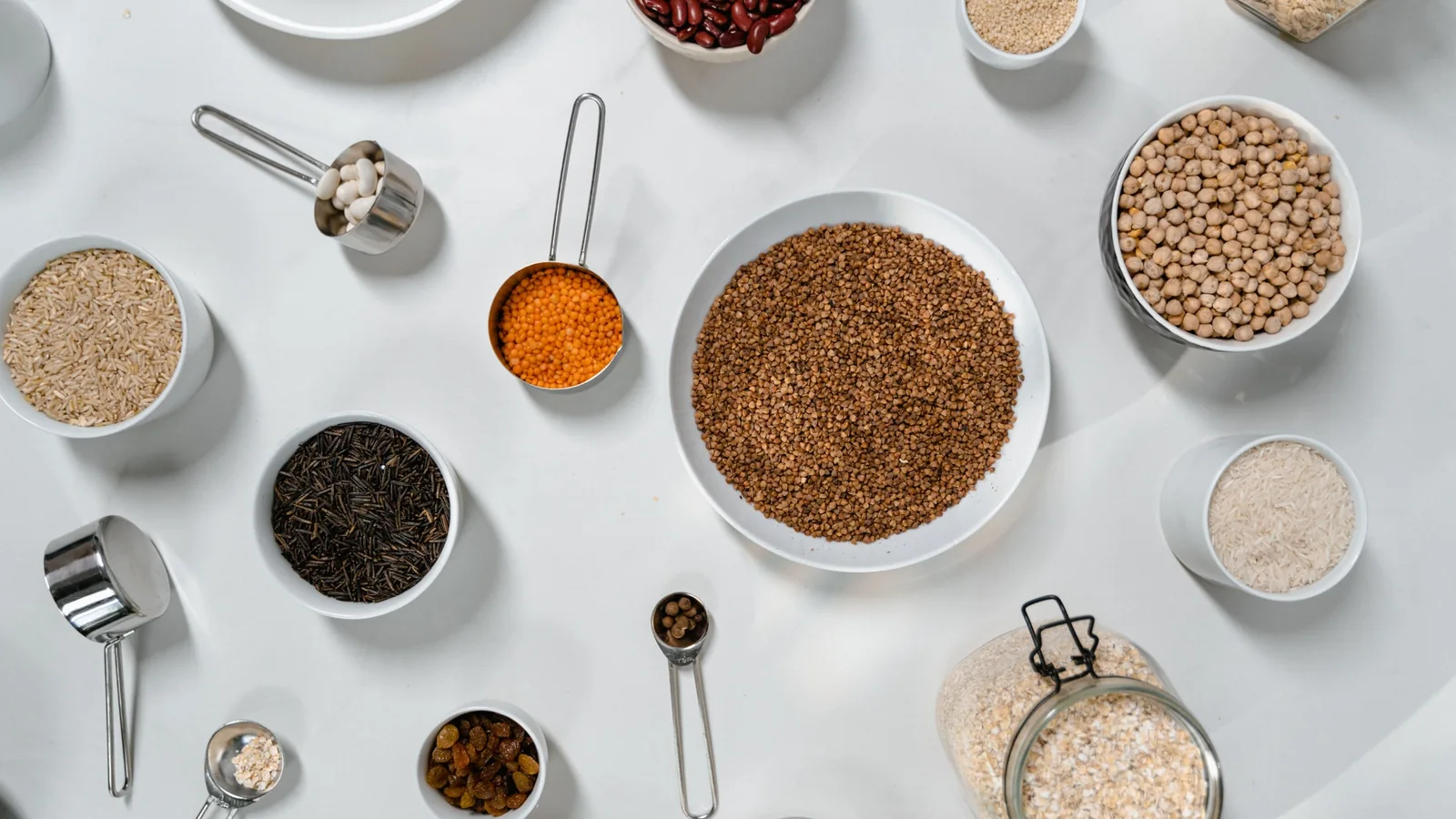
Fibre supplements can help fill a gap in fibre intake, but they do not replace the wider nutrients and food structure of a varied, fibre-rich diet.
What does dietary fibre support?
Different fibres help in different ways. Some absorb water and make stools softer or bulkier; some form a gel that can slow digestion and influence cholesterol or the rise in blood glucose after a meal. Other fibres are used as food by microbes in the large intestine. The benefits depend on the type of fibre, amount and overall diet — not simply the number of grams on the label.
Fermentable fibres can support microbial activity and the production of short-chain fatty acids, but this does not mean that every fibre supplement has proven benefits for every digestive symptom.
Daily intake reference values
| Adults | EU (AI) | USA (AI) |
|---|---|---|
| Women | 25 g | 25 g |
| Men | 25 g | 38 g |
Total daily intake from food and supplements, not a recommended supplement dose. AI = Adequate Intake; AI = Adequate Intake.
USA values shown for ages 19–50; for ages 51+, the AI is 21 g/day for women and 30 g/day for men. These are total dietary fibre intakes, not fibre supplement doses.
Dietary fibre and colorectal cancer risk
There is substantial evidence that diets containing more wholegrains and fibre-rich foods are associated with a lower risk of colorectal cancer (cancers of the colon and rectum). The World Cancer Research Fund concludes that wholegrains and foods containing dietary fibre decrease colorectal cancer risk. This evidence comes largely from long-term dietary studies and supporting biological evidence; it is not proof that a particular fibre supplement prevents cancer.
Possible explanations include increased stool bulk, changes in intestinal transit and microbial fermentation that produces short-chain fatty acids, including butyrate. These mechanisms help explain the research, but they do not establish a cancer-prevention benefit for every isolated fibre ingredient.
For cancer-risk reduction, the practical priority is a varied food pattern rich in wholegrains, beans, vegetables and fruit. The WCRF recommends at least 30 g fibre per day from foods, which is a prevention-oriented target rather than the same thing as EFSA’s 25 g/day Adequate Intake for normal bowel function.
Soluble vs insoluble fibre: what is the difference?
Soluble fibre disperses or dissolves in water. Some soluble fibres, such as psyllium and oat beta-glucan, form a thick gel (they are viscous). Others, including inulin, dissolve without forming much of a gel. This is why “soluble” alone does not tell you what a fibre will do.
Insoluble fibre does not dissolve in water. Coarser fibres, such as wheat bran, can increase stool bulk and help it move through the bowel. Both types occur together in many plant foods, so a varied diet is more useful than trying to eat only one category.
What does fermentable fibre mean?
A fermentable fibre is broken down by bacteria in the large intestine instead of being digested in the small intestine. In the process, bacteria produce compounds called short-chain fatty acids, including acetate, propionate and butyrate. These are part of normal gut metabolism; butyrate is an energy source for cells lining the colon. Fermentation can also produce gas, so rapidly fermentable fibres may cause bloating or discomfort, especially when you suddenly increase the amount.
Solubility and fermentability are different properties. A fibre can be soluble and highly fermentable (such as inulin), soluble and gel-forming but comparatively resistant to fermentation (such as psyllium), or mostly insoluble (such as coarse wheat bran).
Common fibre types in foods and supplements
Psyllium (ispaghula)
A mostly soluble, gel-forming fibre that holds water. It has useful evidence for improving stool consistency and regularity, including in constipation. Take it with sufficient water.
Oat and barley beta-glucan
Viscous soluble fibres. They have specific EU-authorised claims related to cholesterol and post-meal glucose when the relevant conditions are met. Read the beta-glucan guide.
Inulin and fructooligosaccharides (FOS)
Soluble, readily fermentable fibres that can influence gut bacteria but can also cause gas or bloating in some people. Native chicory inulin — a particular form of inulin extracted from chicory root — has an authorised EU claim for normal bowel function by increasing stool frequency when consumed at 12 g per day. It must also meet the claim’s composition requirements; the claim does not apply to every inulin or FOS product.
Partially hydrolysed guar gum (PHGG)
A soluble, fermentable fibre that mixes readily into drinks without the thick gel formed by intact guar gum. Its effects should not be assumed to match either psyllium or regular guar gum; research for particular digestive symptoms is still developing.
Acacia fibre and wheat bran
Acacia gum is a soluble, fermentable fibre. Coarse wheat bran is largely insoluble and can increase stool bulk. Neither should be assumed to suit everyone: comfort and response depend on the type, dose and individual.
Food first: practical ways to increase fibre
Choose oats or wholegrain bread instead of refined grains; include beans or lentils with meals; add vegetables, whole fruit, nuts and seeds. Different foods supply different fibres, so variety is useful.
Increase fibre gradually if your usual intake is low. A rapid increase, especially in fermentable fibres, may cause gas or abdominal discomfort. Drink enough fluid, particularly when using swelling fibres such as psyllium.
Which type of fibre might suit your goal?
Start with what you want the fibre to do. The list below is a practical starting point, not a personalised treatment plan or a ranking of products.
- For hard stools or occasional constipation: Psyllium is often a reasonable first fibre supplement to consider, with stronger supporting evidence for constipation than inulin or bran. Drink enough fluid and increase the amount gradually.
- For improving the overall fibre content of your diet: Add a variety of wholegrains, beans, lentils, fruit, vegetables, nuts and seeds. Different foods provide different combinations of soluble, insoluble and fermentable fibres.
- For cholesterol: Oat and barley beta-glucan can help maintain normal blood cholesterol levels. See our Beta-Glucan Guide for the benefits, effective daily amounts and supplement comparisons.
- For supporting gut microbes: Fermentable fibres such as inulin and certain other prebiotic fibres can be useful dietary substrates. They can also increase gas, and changes in microbiota do not guarantee a noticeable symptom benefit.
- If you are prone to bloating or have IBS: Be cautious with inulin and FOS, which are fermentable fructans and may trigger symptoms. Consider food-based changes or tailored advice; no single fibre is best for everyone.
How to compare a fibre supplement
Check the labelled grams of dietary fibre per daily serving, not just the weight of a scoop, husk or blend. Also check the specific fibre type, serving directions and any other ingredients. A 10 g scoop does not necessarily provide 10 g of dietary fibre.
Increase fibre gradually to help manage bloating. Psyllium must be taken with sufficient water and may not be suitable for people with swallowing difficulties. If you take medicines, check whether they need to be separated from fibre supplements. Seek medical advice for persistent or worsening bowel symptoms, rectal bleeding, unexplained weight loss or a significant change in bowel habits.
Product comparison
Compare fibre supplements
Compare the labelled daily fibre amount, fibre type, serving and vegan suitability. These products use different fibres and are not ranked for effectiveness.
| Product | Dietary fibre / day | Fibre / serving | Manufacturer directions | Fibre type | Format | Vegan |
|---|---|---|---|---|---|---|
| NOW Foods Fiber-3 OrganicView product ↗ | 4–8 g | 4 g | 2½ tbsp (17 g), once or twice daily | Ground flax, acacia and inulin | Powder | Yes |
| NOW Foods Organic Inulin Prebiotic Pure PowderView product ↗ | 4–12 g | 4 g | 1 level tsp (4 g), 1–3 times daily | Inulin/FOS (blue agave) | Powder | Yes |
| California Gold Nutrition Prebiotic Fiber (Sunfiber®)View product ↗ | 5 g | 5 g | 1 scoop (6 g) daily | Partially hydrolysed guar gum (PHGG) | Powder | Yes |
| NOW Foods NutraFlora FOSView product ↗ | Up to 5 g | 5 g / 2 tsp | Begin with ½ tsp; gradually increase to 2 tsp daily | Fructooligosaccharides (FOS) | Powder | Yes |
| NOW Foods Organic Acacia Fiber PowderView product ↗ | 6 g | 6 g | 1 level tbsp (6.5 g) daily | Acacia gum | Powder | Yes |
| NOW Foods Psyllium Husk PowderView product ↗ | 7 g | 7 g | 1 level tbsp (9 g) daily | Psyllium husk | Powder | Yes |
| Thorne FiberMendView product ↗ | 7 g | 7 g | 1 scoop (11 g) daily | PHGG, rice bran, arabinogalactan, pectin | Powder | Not confirmed |
Default order: labelled fibre amount at the comparison serving, lowest to highest; equal amounts alphabetically. Ranges and gradual starting directions are shown where specified. This is not an effectiveness ranking.
The table uses the linked manufacturer’s formulation and directions. Labels and availability may differ by market.
EU health claim details
Authorised claims for specific fibres
There is no single EU-authorised health claim for all dietary fibre supplements. Several claims concern particular fibre types, with precise composition, amounts and other conditions.
Claims have specific use conditions. The transit-time claim includes a daily consumption requirement; the bulk claim is linked to the food meeting “high fibre” criteria.
Claims apply to foods containing the relevant specified grain fibre under the EU conditions of use.
Conditions depend on the particular claim and the amount per serving or per day. See the beta-glucan guide for full wording and doses.
This is a narrowly defined authorised claim for native chicory inulin meeting the specified composition and 12 g/day condition; it is not a generic claim for all inulin or FOS products.
These are summaries, not authorisations for the products in the table. Claim eligibility must be checked against the exact finished-food composition and applicable legal conditions.
Claim use requirements
Consult Commission Regulation (EU) No 432/2012 and amendments for the legally controlling wording and conditions. In particular, the native chicory inulin claim was authorised under Commission Regulation (EU) 2015/2314. A general association between fibre-rich diets and lower colorectal cancer risk is not an EU-authorised cancer-prevention claim for fibre supplements.
Sources & further reading
- EFSA — Dietary Reference Values for carbohydrates and dietary fibre
- US National Academies — Dietary Reference Intakes for fibre
- WCRF — Wholegrains and dietary fibre in cancer prevention
- USDA — Diet patterns and colorectal cancer systematic review
- EUR-Lex — Commission Regulation (EU) 432/2012
- EUR-Lex — native chicory inulin Regulation (EU) 2015/2314
- AGA–ACG (2023) — guideline on chronic idiopathic constipation and fibre supplements
- McRorie & McKeown (2017) — physical properties and clinical effects of different fibres